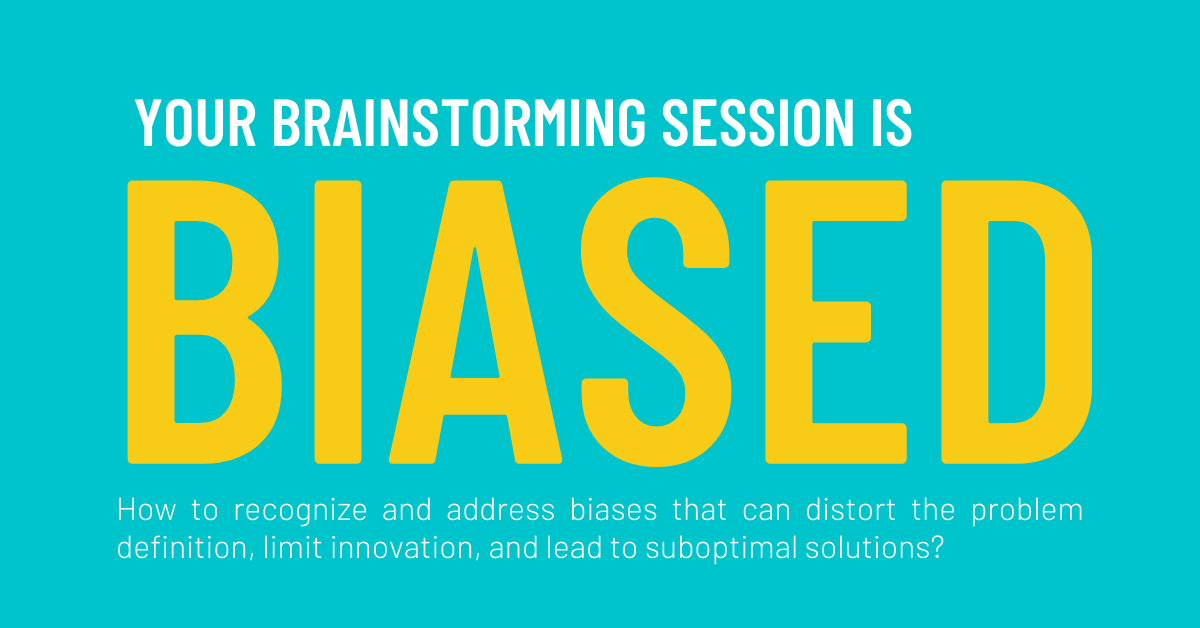
Your Brainstorming Session is Biased
It will take time to become aware of biases in your brainstorming sessions and to understand how to address them without ruining the atmosphere.
Here is a brief list of the most common ones.
Status quo bias
You know what? Let’s just leave things as they are.
It means that people are more likely to choose options that preserve the current situation or maintain the status quo rather than make a change.
Confirmation bias
I like the most the idea that my team has suggested because users like these types of features best.
People tend to favor information confirming their beliefs or values while disregarding information contradicting it by providing subjective, unsupported justifications.
Anchoring bias
Let’s stick with the idea we discussed earlier.
It’s the best we’ve got.
We become anchored to what we see first, affecting our judgment on everything after that.
Hallo effect bias
We should include this feature in the MVP because our top investor wants it.
We give too much weight to one good quality or feature and overlook others.
Optimism bias
This idea will solve all of our problems. Our users will love it!
We are showing a tendency to be overly optimistic and to overlook potential challenges and risks.
Fundamental attribution error bias
This idea won’t work because the person who came up with it doesn’t have any industry-related experience.
Attributing a failure or lack of success to a person’s inherent characteristics or personality traits rather than to situational factors or external circumstances
“I know what’s best” and “I’ve always done it this way” are successfully followed by confirmation bias and people seeking the information to confirm their existing beliefs—or anchoring bias, where folk get stuck on one idea and cannot see past it.
People also often show halo effect bias, give too much weight to one good quality or feature, and overlook others, and optimism bias, where they forget about potential risks by focusing too much on potential rewards.
Some biases can distort the problem definition, limit innovation, and lead to suboptimal solutions, while others can impact the atmosphere and lead to severe, long-lasting conflicts.
One that is quite often is fundamental attribution error bias. It’s not surprising, we do it a lot in everyday life, and we do it in brainstorming sessions too. We’ll say people are late for the meeting because of their irresponsibility, but we’re not irresponsible if we’re late to pick up our kid from kindergarten later. It’s due to traffic. They support X solution because that works for their team better, but when we do it, it is because it is the best solution our company can think of.
Whenever you notice them, the easiest thing to do is remind people to stay open because possibilities are endless and encourage collaboration. In any situation, ignore finger-pointing and switch the focus- it is not your job to teach them communication and collaboration skills. Your job is to stay focused on solutions. You’ll sometimes get triggered because you’re just as human as they are. It helps to remember why you’re there and save frustrations for your shrink.